
Build Horizon Europe Impact with iED
iED works with research organisations, universities, SMEs, public authorities, healthcare actors, innovation ecosystems and Horizon Europe coordinators to transform project ideas into adoption-ready results.
Whether you are shaping a new concept, building a consortium, validating an innovation, preparing a go-to-market strategy or looking for real-world adoption pathways, iED helps turn research and innovation into measurable impact.
From Research to Results, Adoption and Market Uptake
Horizon Europe projects are expected to deliver more than excellent research. They must create results that can be validated, adopted, scaled, commercialised, transferred or embedded into real-world practice.
This is where iED adds value.
We help Horizon Europe consortia strengthen the full pathway from research and innovation to exploitation, go-to-market readiness, societal impact, stakeholder adoption and long-term sustainability.
Our work focuses on: understanding user needs, engaging stakeholders, validating solutions, developing exploitation strategies, communicating results, building skills, supporting pilots and turning outputs into usable innovation assets.
We are an implementation, innovation and ecosystem-building organisation that helps Horizon Europe projects become stronger, more visible, more usable and more sustainable.
Horizon Europe Pillars
The Horizon Europe programme structure is divided into three Pillars. Each Horizon Europe Pillar defines the different types of missions, topics and projects that will be funded.
- Pillar I: Excellent Science focuses on encouraging and funding frontier research. (European Research Council - ERC, Marie Skłodowska-Curie Actions - MSCA, Research Infrastructures)
- Pillar II: Global Challenges and European Industrial Competitiveness develop a shared vision and support the uptake of innovative solutions in industry and society. (6 Clusters, Joint Research Centre)
- Pillar III: Innovative Europe aims at funding research to produce European innovations. (European Innovation Council, European Innovation Ecosystems, European Institute of Innovation and Technology)
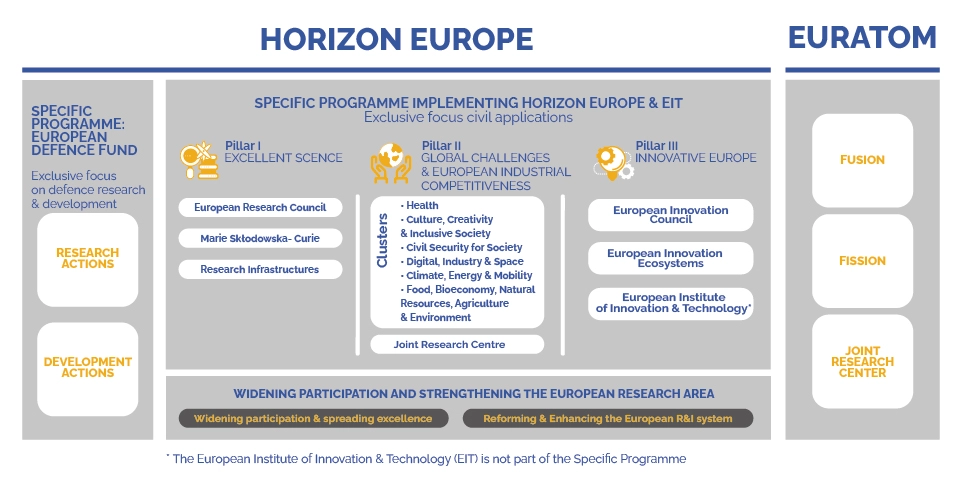
The three Horizon Europe Pillars are complemented by the addition of another horizontal Pillar, entitled “Widening Participation and Strengthening the European Research Area”.
It comprises two components, Sharing Excellence and Reforming the R&I Systems. These components are designed to assist all EU Member States in increasing their national research and innovation potential.
Additionally, they aim to promote cross-cutting issues, foster collaborations, and spread excellence across the region.
Horizon Europe Areas Where iED Can Contribute
Our Horizon Europe implementation portfolio covers several areas, including Health, Digital and Industry, Climate, Security, WIDERA, European Innovation Ecosystems and EU Missions.
Health
iED supports health and digital health projects through stakeholder engagement, digital health adoption, mHealth, healthcare ecosystem access, pilot support, training, exploitation, communication and SSH-informed user validation.
Typical contribution: digital health adoption, healthcare stakeholder mobilisation, user needs analysis, training, exploitation and sustainability.
Culture, Creativity & Inclusive Society
iED contributes through social innovation, inclusion, entrepreneurship, skills development, education, civic participation, cultural innovation, community engagement and participatory methodologies.
Typical contribution: SSH integration, inclusion strategies, community engagement, social impact and skills development.
Civil Security for Society
iED can support security projects with practitioner engagement, training, public awareness, behavioural preparedness, communication, stakeholder engagement, exploitation and uptake pathways.
Typical contribution: practitioner engagement, awareness campaigns, training, behavioural insights and adoption support.
Digital, Industry & Space
iED contributes to digital and industrial projects through Industry 5.0 adoption, digital skills, human-centred technology uptake, stakeholder validation, business models, exploitation and go-to-market pathways.
Typical contribution: digital adoption, SSH integration, skills, SME engagement, exploitation and market uptake.
Climate, Energy & Mobility
iED supports sustainability and climate-related projects through citizen engagement, stakeholder mobilisation, capacity building, behavioural change, communication, exploitation and adoption pathways.
Typical contribution: climate resilience engagement, training, social acceptance, local stakeholder mobilisation and uptake planning.
WIDERA, EIE & Missions
iED supports widening participation, innovation ecosystems, regional innovation initiatives, smart specialisation, mission-oriented activities, ecosystem building, open innovation and cross-sector collaboration.
Typical contribution: ecosystem activation, stakeholder engagement, capacity building, entrepreneurship, go-to-market support and impact pathways.
Choose iED as the experienced project partner that you are looking for
How You Can Work with Us
iED collaborates with organisations at different stages of the Horizon Europe journey: from early idea development to full implementation and post-project uptake.
Co-create a Horizon Europe Concept
Bring us your challenge, call topic or early project idea.
We can help shape the concept, identify the strongest impact logic, define target groups and stakeholders, and clarify how the project can move from research to validated results and real-world adoption.
This is especially useful for organisations that have strong technical, scientific or policy expertise but need support in exploitation, stakeholder engagement, SSH integration, training, dissemination, adoption or go-to-market planning.
Build or Strengthen a Consortium
iED can support consortium development by bringing implementation capacity, stakeholder access, SSH expertise, exploitation know-how, communication strength and practical delivery experience.
We can contribute as a Work Package leader, task leader, exploitation partner, dissemination leader, stakeholder engagement partner, SSH integration partner, training provider, pilot support partner or market uptake facilitator.
Validate Innovation with Real Users and Ecosystems
Horizon Europe innovations need to be tested with the people and organisations that will actually use them.
iED supports real-world validation through stakeholder mapping, user engagement, co-creation activities, pilot support, workshops, interviews, surveys, feedback loops, training activities and adoption-readiness assessment.
We help projects understand what works, what needs improvement and what is required for future uptake.
Turn Project Results into Go-to-Market Pathways
Many Horizon Europe projects produce promising results but struggle to move them beyond deliverables.
iED helps projects identify exploitable results, map target users and adopters, assess market and policy opportunities, design sustainability models, develop business-oriented pathways and prepare go-to-market or uptake roadmaps.
Our goal is to help research outputs become usable services, tools, methods, models, platforms, products, policy recommendations or ecosystem assets.
Access Innovation and Health Ecosystems
Through our networks, Health Hub activities and innovation ecosystem, iED can help projects connect with relevant stakeholders, SMEs, startups, healthcare professionals, public authorities, education actors, regional ecosystems, innovation organisations and end-user communities.
This is particularly valuable for Horizon Europe projects that need real-world access, user validation, stakeholder mobilisation, pilot engagement, digital skills activities or adoption pathways.
Where iED Adds Value in Horizon Europe Projects
iED contributes to Horizon Europe projects where research, innovation and technology need to become visible, usable, adopted and sustainable.
Exploitation, Sustainability & Go-to-Market
We support exploitation strategies, sustainability planning, value proposition design, stakeholder and market mapping, business modelling, early adopter identification, go-to-market roadmaps and recommendations for scaling.
- Exploitation strategies
- Key exploitable results analysis
- Sustainability plans
- Business models
- Value propositions
- Market and stakeholder mapping
- Go-to-market roadmaps
- Adoption and uptake pathways
- Recommendations for scale-up and transferability
Research, Innovation & Impact Pathways
We help consortia define how project results will reach target users, how stakeholders will be involved, how innovation will be validated and how impact will be demonstrated during and after the project.
- Impact pathways
- Result-oriented implementation logic
- Stakeholder and user journey mapping
- Innovation uptake plans
- Adoption-readiness assessment
- Impact narratives
- KPI and evidence frameworks
- Reporting-ready impact summaries
SSH Integration & Human-Centred Innovation
Our Social Sciences and Humanities contribution helps projects address user needs, behavioural factors, social acceptance, inclusion, skills gaps, adoption barriers, organisational change, ethics communication, policy relevance and societal impact.
As an SSH partner, iED helps ensure that project results are not only technically sound, but also usable, inclusive, trusted, scalable and relevant to society.
- SSH integration strategies
- Stakeholder mapping
- User needs analysis
- Co-creation methodologies
- Participatory workshops
- Behavioural and adoption-barrier analysis
- Social impact assessment
- Inclusion and accessibility approaches
- Gender-sensitive engagement
- User validation and feedback analysis
- Policy and practice recommendations
- Societal adoption roadmaps
Dissemination, Communication & Outreach
We translate complex research and technical outputs into clear messages for stakeholders, end users, policymakers, SMEs, citizens, practitioners and innovation communities.
- Dissemination and communication strategies
- Project branding and messaging
- Websites and digital channels
- Social media campaigns
- Newsletters and articles
- Policy briefs
- Videos and visual assets
- Event communication
- Stakeholder outreach
- Communication analytics and reporting
Stakeholder Engagement & Ecosystem Activation
We help consortia identify, mobilise and engage the stakeholders who can validate, adopt, promote, scale or benefit from project results.
- Stakeholder engagement strategies
- Ecosystem mapping
- Consultation plans
- Community-building activities
- Multi-actor workshops
- End-user feedback loops
- Matchmaking and networking activities
- Practitioner engagement
- Adoption-oriented stakeholder recommendations
Training, Skills & Capacity Building
We design and deliver training and capacity-building activities that help target groups understand, use and adopt project results.
- Training needs analysis
- Curricula and learning paths
- Training modules
- E-learning materials
- MOOCs
- Workshops and webinars
- Train-the-trainer programmes
- Digital skills activities
- Learning evaluation frameworks
- Skills assessment reports
Pilot Support, Validation & Evidence Collection
Our contribution is especially valuable when projects need to test solutions with SMEs, healthcare professionals, public authorities, citizens, learners, practitioners, innovation ecosystems or end-user communities.
- Pilot engagement plans
- User recruitment and mobilisation
- Surveys and interviews
- Validation workshops
- Feedback collection
- User acceptance analysis
- Pilot communication support
- Adoption-readiness insights
- Evidence for deliverables and review meetings
Open Calls, FSTP & Innovation Support
We support projects that distribute funding to startups, SMEs, innovators, researchers or local ecosystems through open calls and cascade funding.
- Open call frameworks
- Applicant guidelines
- Outreach campaigns
- FAQ and communication materials
- Evaluation process support
- Beneficiary onboarding
- Mentoring and support programmes
- Portfolio monitoring
- Open call impact reporting
Digital Tools, Platforms & Learning Environments
We can contribute to projects through digital outputs that support training, communication, stakeholder engagement, project visibility and result uptake.
- Project websites
- E-learning platforms
- Digital training environments
- Online toolkits
- Stakeholder engagement portals
- Digital repositories
- Interactive learning content
- User-oriented digital resources
SSH Integration for Research, Innovation and Societal Adoption
iED supports consortia as an SSH integration partner by bringing human-centred, behavioural, educational, social and stakeholder-oriented expertise into research and innovation projects.
This is particularly relevant for projects in health, digital transformation, AI, Industry 5.0, climate resilience, security, public services, education, inclusion, innovation ecosystems and regional development.
iED’s SSH Contribution Can Support:
User needs and adoption barriers
Understanding what target users need, what prevents adoption and what conditions are required for uptake.
Co-creation and participatory design
Engaging stakeholders and end users in the design, testing and refinement of project solutions.
Behaviour change and skills development
Designing training, awareness and capacity-building activities that support new behaviours, skills and practices.
Inclusion and accessibility
Ensuring that project results consider diverse users, vulnerable groups, gender dimensions, accessibility needs and social inequalities.
Social impact and policy relevance
Connecting project outputs with societal challenges, policy priorities, public value and long-term impact.
Ethics communication and trust-building
Helping technical and research partners communicate complex topics such as AI, cybersecurity or health innovation with credibility.
iED Supports Health and Digital Health Projects
Through our EU project portfolio and our role as coordinator of EDIH Health Hub, we support projects working on AI-enabled health solutions, mHealth applications, digital health adoption, healthcare digitalisation, public health resilience, stakeholder engagement and real-world deployment.
- Exploitation strategies and adoption roadmaps
- Go-to-market and sustainability planning
- Healthcare stakeholder engagement
- Mobilisation of hospitals, clinicians, SMEs and authorities
- Real-world user engagement and validation
- Communication, dissemination and community building
- Digital skills training for medical and administrative teams
- Pilot support and feedback collection
- Test-before-invest and deployment support
- Impact, policy and evaluation frameworks
- Preneurship, go-to-market support and impact pathways
Typical Roles for iED in
Horizon Europe Collaborations
Exploitation and sustainability leader
Go-to-market and innovation uptake partner
SSH integration partner
Human-centered innovation partner
Dissemination, communication and outreach leader
Stakeholder engagement and ecosystem activation partner
Training and capacity-building partnery
Pilot support and end-user validation partner
Open call and cascade funding management partner
Impact monitoring and reporting-support partner
Digital tools and e-learning partner
Policy, practice and adoption pathway partner
Our Research Activities
Partner With Us
Share your call topic, challenge, project idea or draft concept with iED. Our team will review the opportunity and identify how we can work together.