

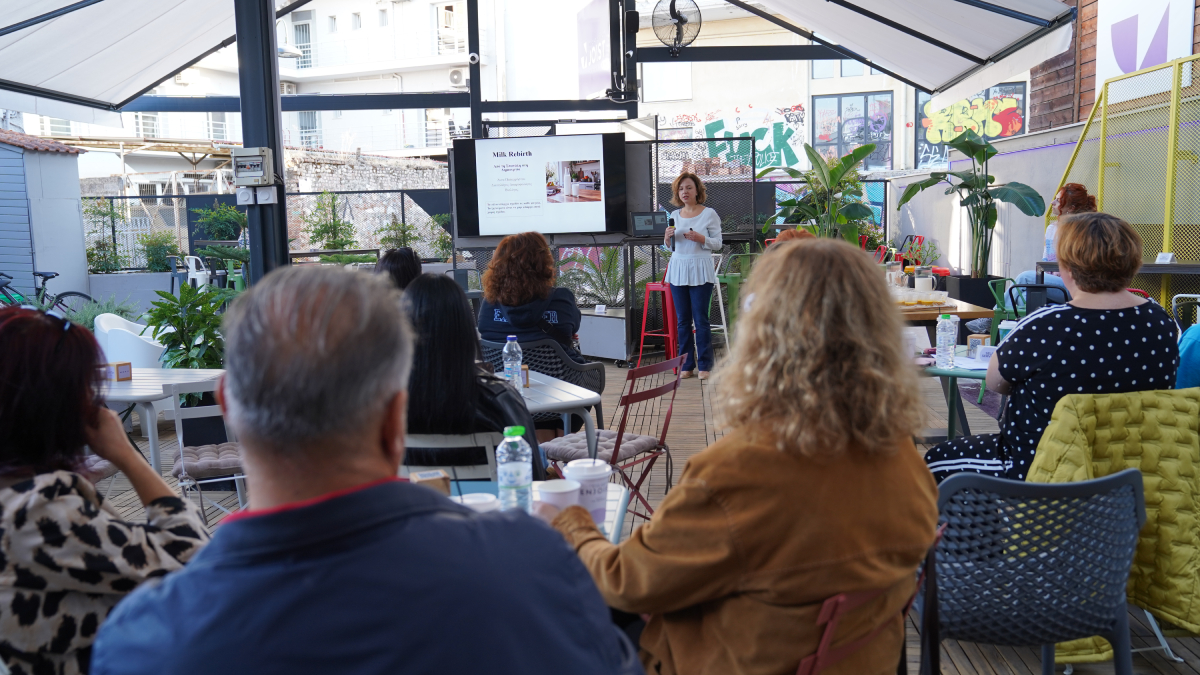
On Wednesday, 30 September 2026, the outdoor area of JOIST Innovation Space in Larissa hosted “Milk Rebirth: From Waste to Creation”, an experiential activity focusing on household food waste, responsible food management, and the importance of seasonality in our everyday food choices.
The activity was organised within the framework of the European project FOODPrint, implemented by organisations from six European countries and focusing on the connection between everyday food choices, sustainable consumption, and the environmental footprint of food. The project’s main objective is to empower young people to better understand the consequences of their consumption choices, adopt more sustainable practices, and actively contribute to building a more environmentally responsible society.
At the heart of FOODPrint are young people and youth workers. Through experiential activities and non-formal learning tools, the project does not approach young people simply as recipients of information, but as active agents and multipliers of change, able to share new ideas and practices with their peers, families, and communities.
Milk Rebirth followed the Bake Off Challenge, held on 23 June 2026, continuing the project’s focus on reducing food waste and creatively using ingredients that are often already available in our kitchens.
This time, the spotlight was on milk, a product found in most households on a daily basis which, due to its relatively short shelf life, can easily end up being discarded if it is not consumed or used in time.
Food Waste Often Starts with Small Everyday Habits
Food waste is not only an issue for large production chains or food service businesses. A significant part of it begins at home: products forgotten in the fridge, quantities purchased without proper planning, or food discarded even though it could still have been used in time.
This is precisely why the participation of young people, youth workers, and parents in activities such as Milk Rebirth is so important. Young people can become drivers of new ideas and habits, youth workers can transfer the project’s messages and methods to the groups of young people they work with, while parents and families are a crucial link in putting these practices into action at home. In this way, changes in how we buy, store, cook, and ultimately use food can move beyond awareness and become part of everyday life.
Through Milk Rebirth, milk was used as a simple and relatable example to demonstrate how small changes in our daily routines can help reduce food waste. Better fridge organisation, planning our shopping, consuming products in time, and making use of ingredients we already have at home can all make a meaningful contribution to reducing food waste.
One Ingredient, Four Seasons
The second key dimension of the event was seasonality. Through the theme “Four Seasons on a Plate”, milk became the common ingredient connecting four different approaches, adapted to the flavours and ingredients available in each season: fresher choices in spring, lighter options in summer, richer flavours in autumn, and warm dishes in winter.
In this way, seasonality was presented not only as a dietary choice, but also as a practical way to make better use of the ingredients available to us throughout the year.
The ENJOIST chef presented four recipes, one for each season:
- Spring – Rizogalo (Greek Rice Pudding): milk, short-grain rice, vanillin, cornflour, sugar, cinnamon, lemon and orange zest, salt, and butter.
- Summer – Galatopita (Greek Milk Pie): milk, butter, feta cheese, Gouda, Parmesan, oregano, cornflour, sugar, salt, and pepper.
- Autumn – Chestnut Pastry Cream: milk, sugar, egg, vanillin, butter, cornflour, and boiled chestnuts.
- Winter – Pumpkin Soup with Honey and Thyme: milk, pumpkin, onion, garlic, olive oil, butter, thyme, and honey.
Only milk that was safe for consumption was used for the preparation and tasting of the recipes. The message of the activity was clear: the aim is not to consume food products that are no longer safe, but to make timely use of them before they reach the point where they need to be discarded.
From Awareness to Everyday Practice
Alongside the recipes, dietitian Anna Papachristou presented the nutritional value of the dishes, highlighted the importance of seasonality, and suggested practical alternatives for different dietary needs.
Particular attention was given to issues directly relevant to every household: how to organise our fridge more effectively, what we can do when a product is approaching its use-by or best-before date, how to make use of leftovers and ingredients already available at home, and why choosing seasonal products matters.
This connection between awareness and action is an important part of the FOODPrint approach. The project aims to ensure that knowledge about sustainable consumption does not remain theoretical but is translated into practical skills and more conscious choices. The results achieved so far demonstrate strengthened capacities among youth workers, the activation of young people as multipliers of change, and increased awareness of sustainable food systems and conscious, sustainable consumption.
From a Single Activity to Changing Everyday Habits
The real impact of Milk Rebirth and FOODPrint goes beyond a single event or discovering four new recipes. The aim is for experiences like this to become a starting point for small but meaningful changes in behaviour: thinking before we buy, better organising what we already have at home, using food in time, avoiding unnecessary purchases, and choosing seasonal products more often.
For young people, this change can have an even greater multiplier effect. A young person who begins to approach food waste differently can bring this attitude into their home and share it with friends and peers. A youth worker can integrate sustainable consumption into activities with groups of young people. And a family that changes small everyday habits can gradually reduce the amount of food that ends up being thrown away.
This is the broader impact that FOODPrint seeks to achieve: contributing to a more conscious and sustainable food culture while empowering young people in particular to play an active role in this change. Sustainability thus becomes something much more tangible than an abstract environmental concept; it becomes part of the choices we make every day, from what we buy to what we ultimately decide to throw away.
Milk Rebirth demonstrated that reducing food waste does not necessarily require major changes. It can begin with the everyday choices made in each household: shopping more consciously, better organising what we already have, using food before it goes to waste, and adapting our cooking to the season and the ingredients available to us.
Through activities such as the Bake Off Challenge and Milk Rebirth, FOODPrint brings the conversation about sustainability closer to everyday life and creates opportunities for young people, youth workers, parents, and the wider community to take part. Because tackling food waste can start from the simplest place of all: our kitchen, our fridge, and the choices we make every day.
Learn more about FOODPrint.
